Energetic Consciousness Theory — Canonical Diagrams
The following diagrams define the canonical structural framework of Energetic Consciousness Theory. They describe constraint relationships and organisational limits rather than mechanisms or prescriptions. Extended analysis and applications are developed in the associated publications.
Energetic Constraint Cascades
Energetic constraints propagate across regulatory layers, producing cumulative downstream effects rather than isolated failures.
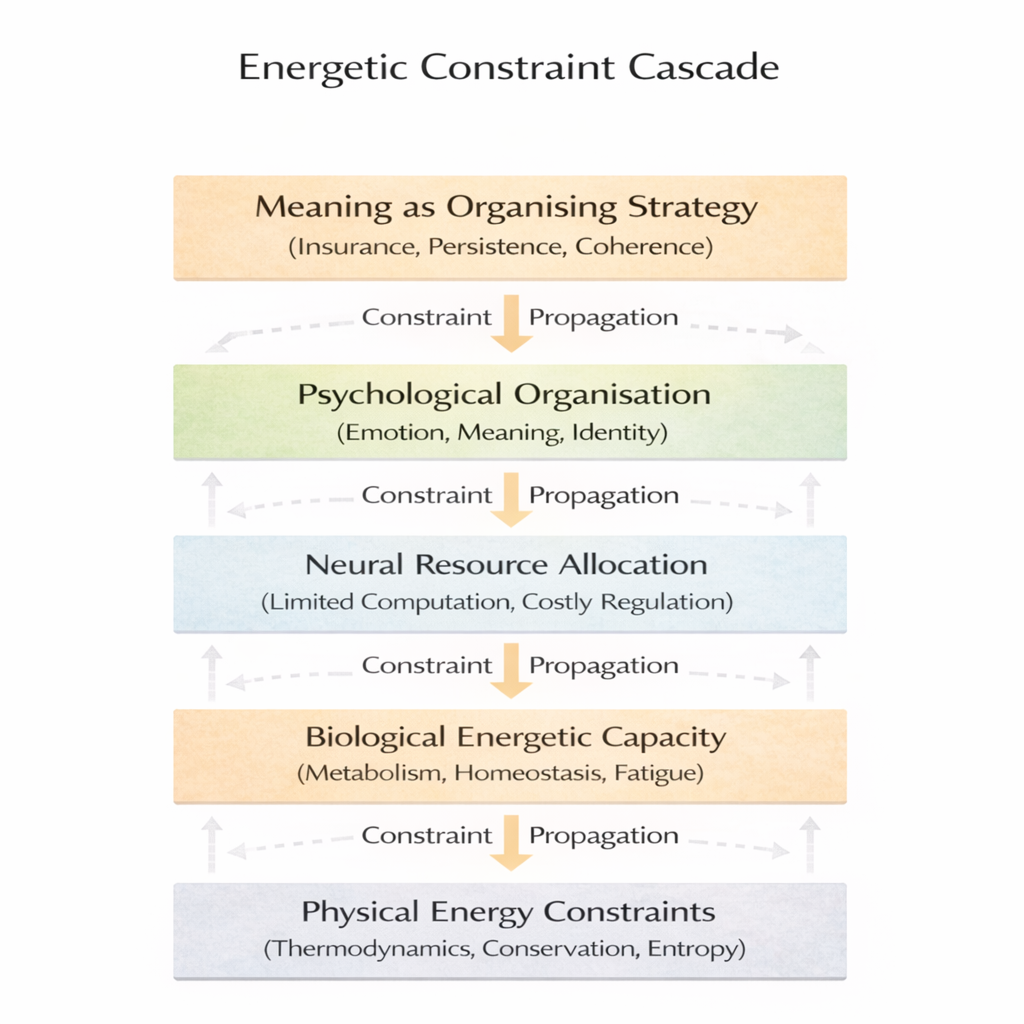
When energetic demand persistently exceeds available capacity, compensatory regulation shifts burdens across systems and timescales. These shifts accumulate as latent strain, creating cascades of constraint that remain behaviourally invisible until compensatory margins are exhausted.
Reference: Foundations, Chapter II–III
Energetic Bandwidth of Organisation
Conscious functioning operates within a bounded energetic bandwidth that constrains the range and stability of viable states.
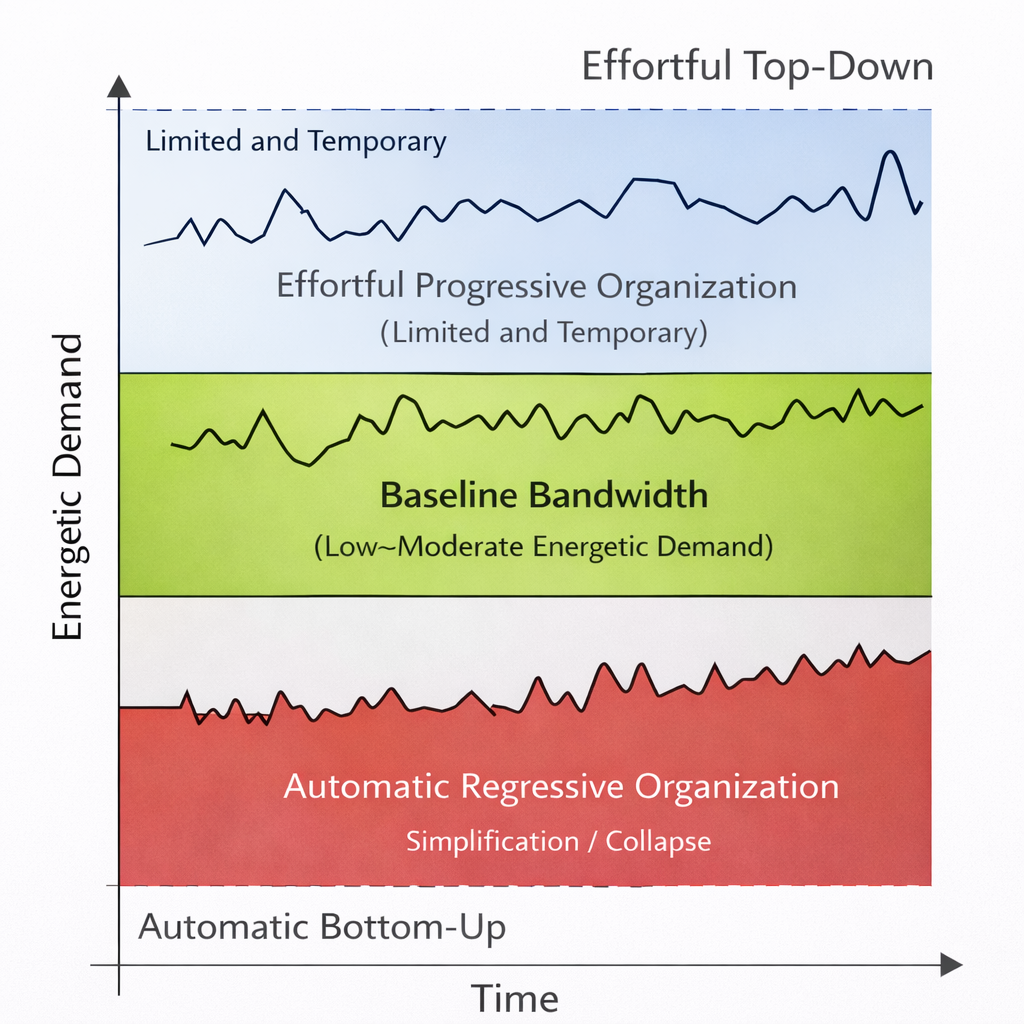
This diagram represents the finite energetic space within which conscious regulation can be sustained. States outside this bandwidth cannot be maintained without degradation, forcing simplification, rigidity, or breakdown as energetic margins narrow.
Reference: Foundations, Chapter II
Energetic Demand Over Time
Energetic demand accumulates incrementally over time, even when outward behaviour appears stable.
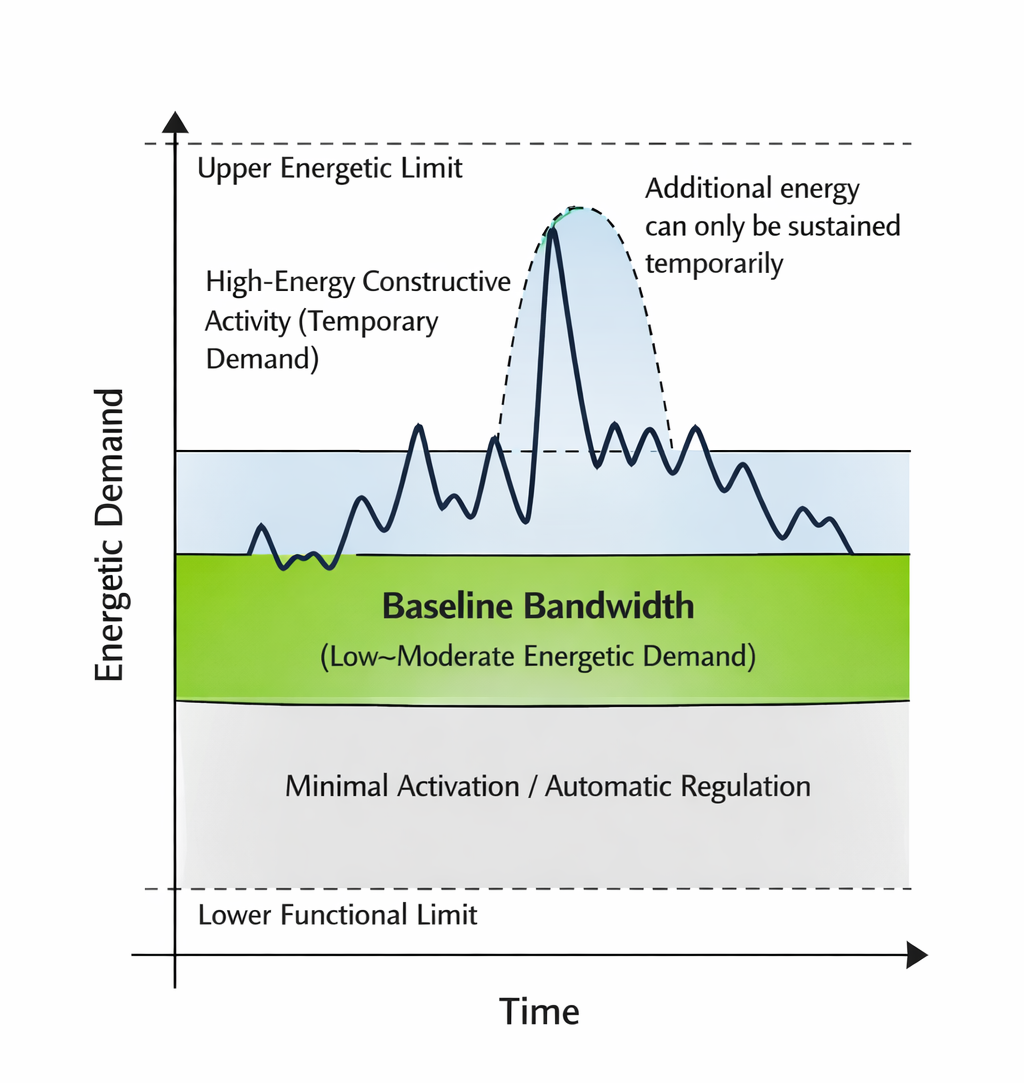
Sustained regulatory effort produces energetic debt that is not immediately expressed in behaviour. This temporal accumulation explains why collapse often appears sudden despite long periods of apparent stability.
Reference: Foundations, Chapter III
Latent Attractors Under Baseline Conditions
Even under baseline, non-stressed conditions, conscious systems are shaped by latent behavioural attractors that remain unexpressed until energetic constraint intensifies.
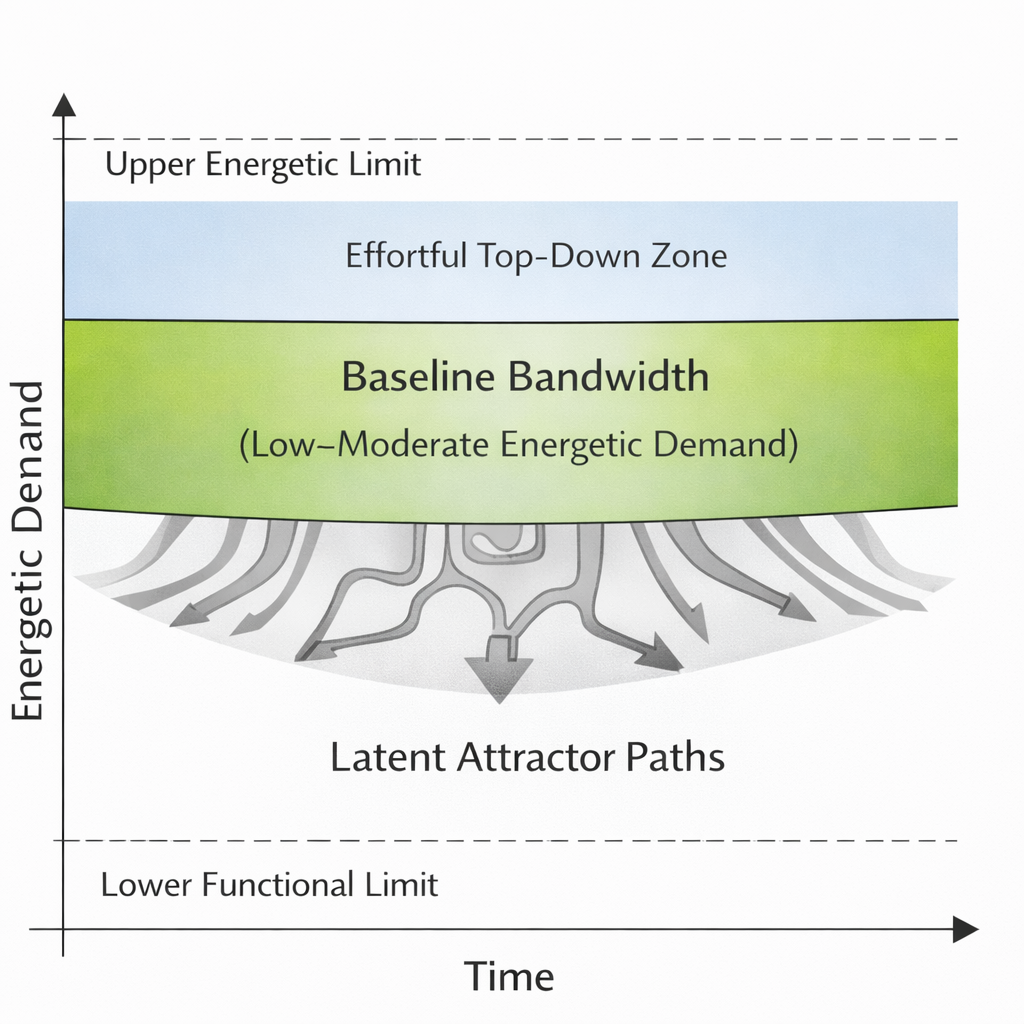
This diagram illustrates how multiple potential attractors coexist beneath apparent behavioural neutrality. While sufficient energetic bandwidth allows flexible regulation and suppresses their expression, these latent structures nonetheless shape probability, readiness, and direction of future behavioural convergence. Under increasing constraint, regulation weakens and these attractors become selectively activated rather than newly formed.
Reference: Foundations, Chapter III
Attractor Capture Under Energetic Constraint
Under energetic constraint, behaviour stabilises around a limited set of attractors that minimise regulatory cost.
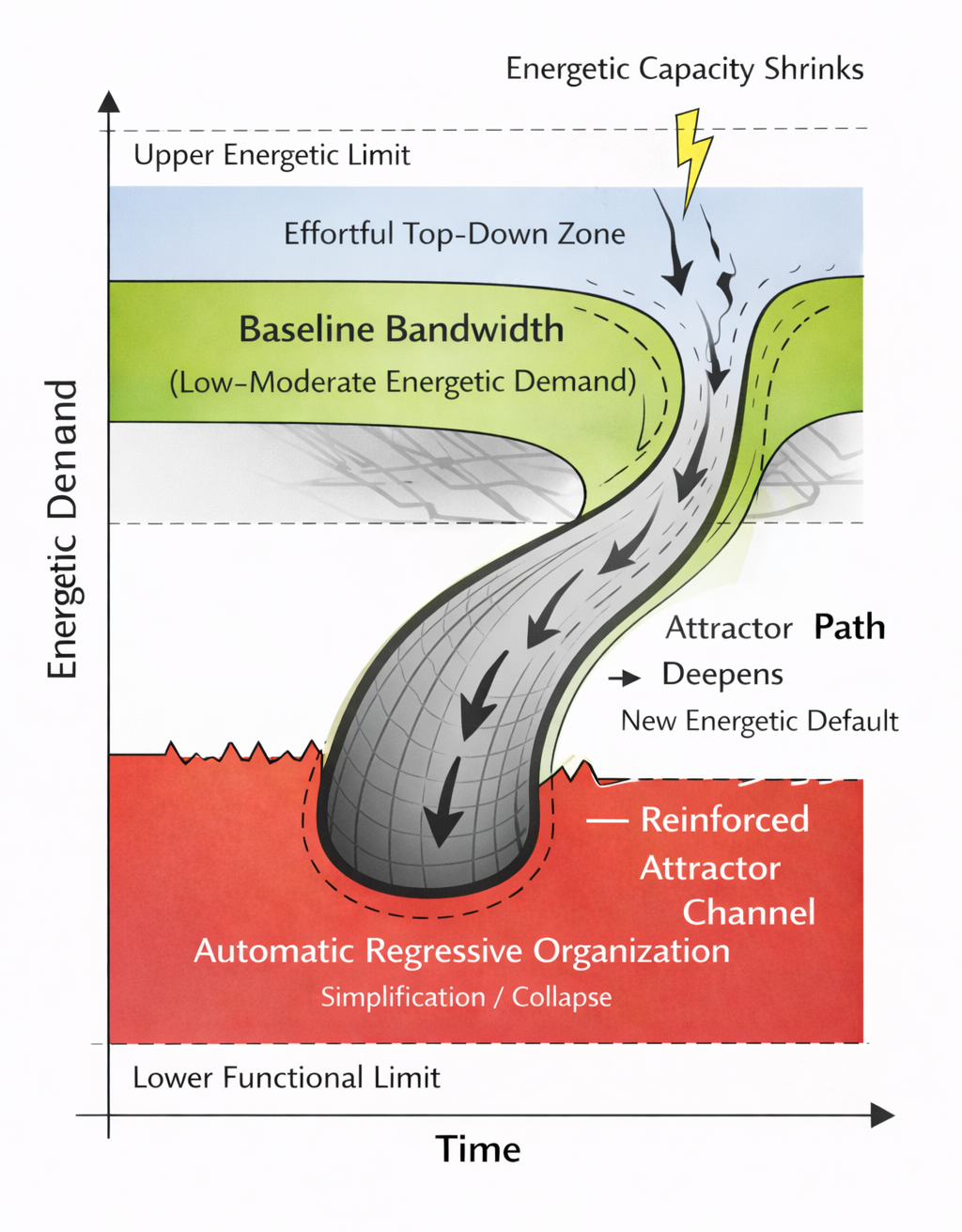
As energetic bandwidth narrows, flexible regulation becomes unsustainable. Behaviour increasingly converges toward habitual, rigid, or simplified patterns that reduce energetic expenditure, even when they are suboptimal or destructive.
Reference: Foundations, Chapter III–IV
Directional Asymmetry Around Baseline
Departures from baseline are directionally asymmetric: movement toward degradation or collapse occurs more readily and at lower energetic cost than movement toward recovery or enhancement.
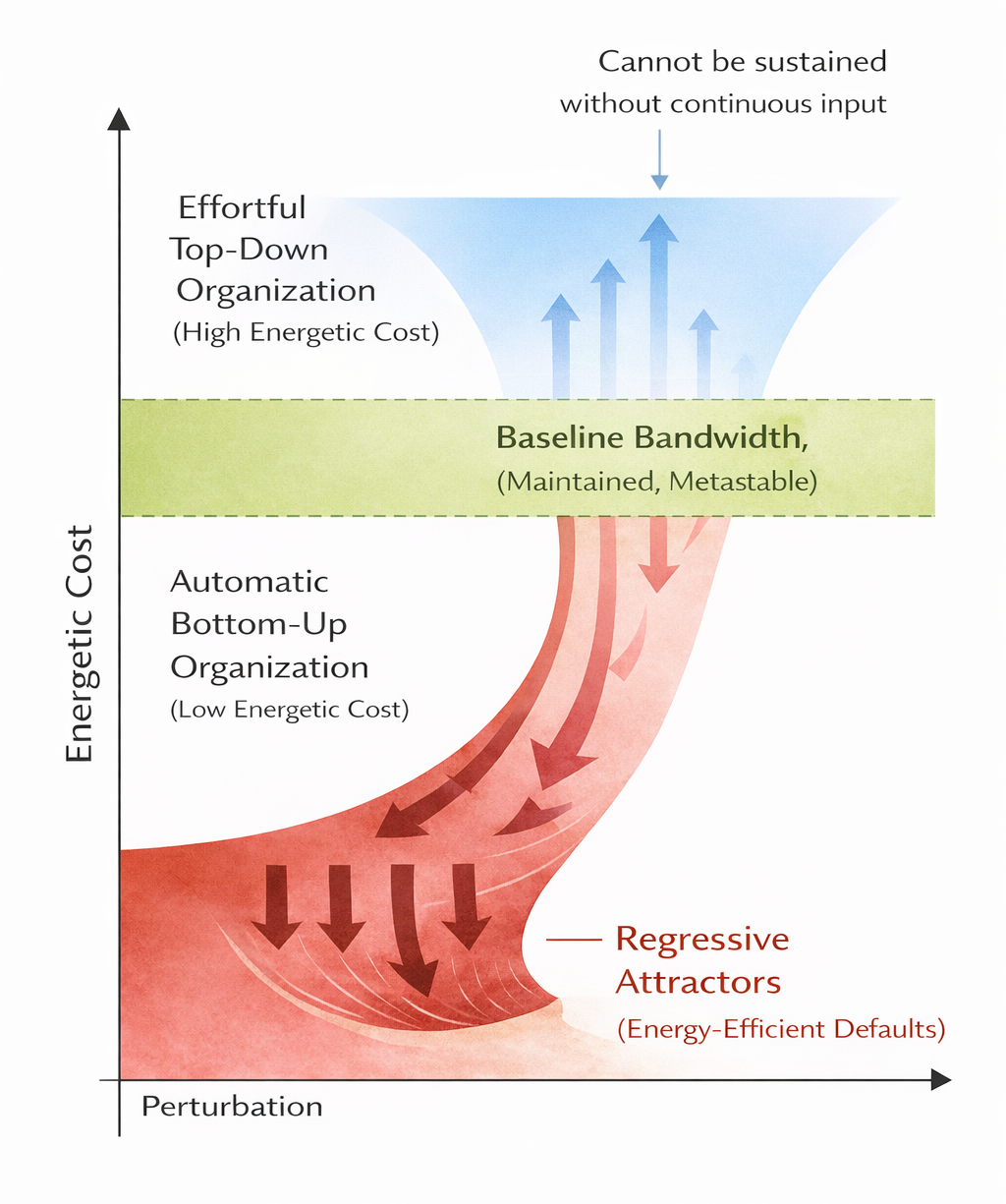
This diagram captures the unequal energetic requirements governing change around baseline functioning. Downward shifts—toward simplification, rigidity, or breakdown—require progressively less regulatory effort as energetic margins narrow. By contrast, upward shifts—toward restoration, flexibility, or growth—demand sustained surplus capacity and coordinated regulation. The asymmetry explains why decline is typically rapid while recovery is slow, fragile, and incomplete.
Reference: Foundations, Chapter IV
Latent Instability and Delayed Collapse
Collapse is the delayed expression of accumulated energetic incoherence, not an abrupt loss of control.
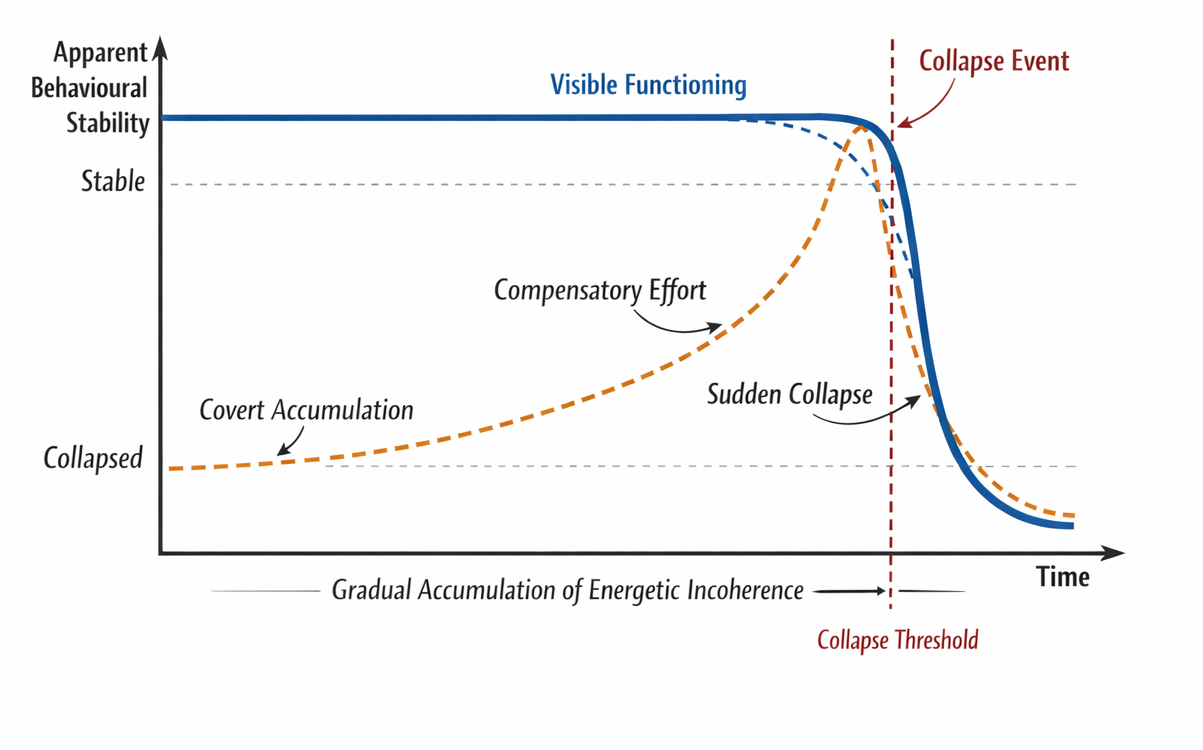
This diagram shows how systems can remain behaviourally coherent while becoming structurally fragile. Once compensatory capacity is exceeded, reorganisation occurs rapidly, giving the appearance of sudden breakdown despite gradual energetic deterioration.
Reference: Foundations, Chapter IV
Psychological Organisation Under Energetic Constraint
Psychological organisation emerges as a constrained regulatory layer that mediates between fixed energetic limits and higher-order meaning, collapsing toward simpler forms as energetic cost rises.
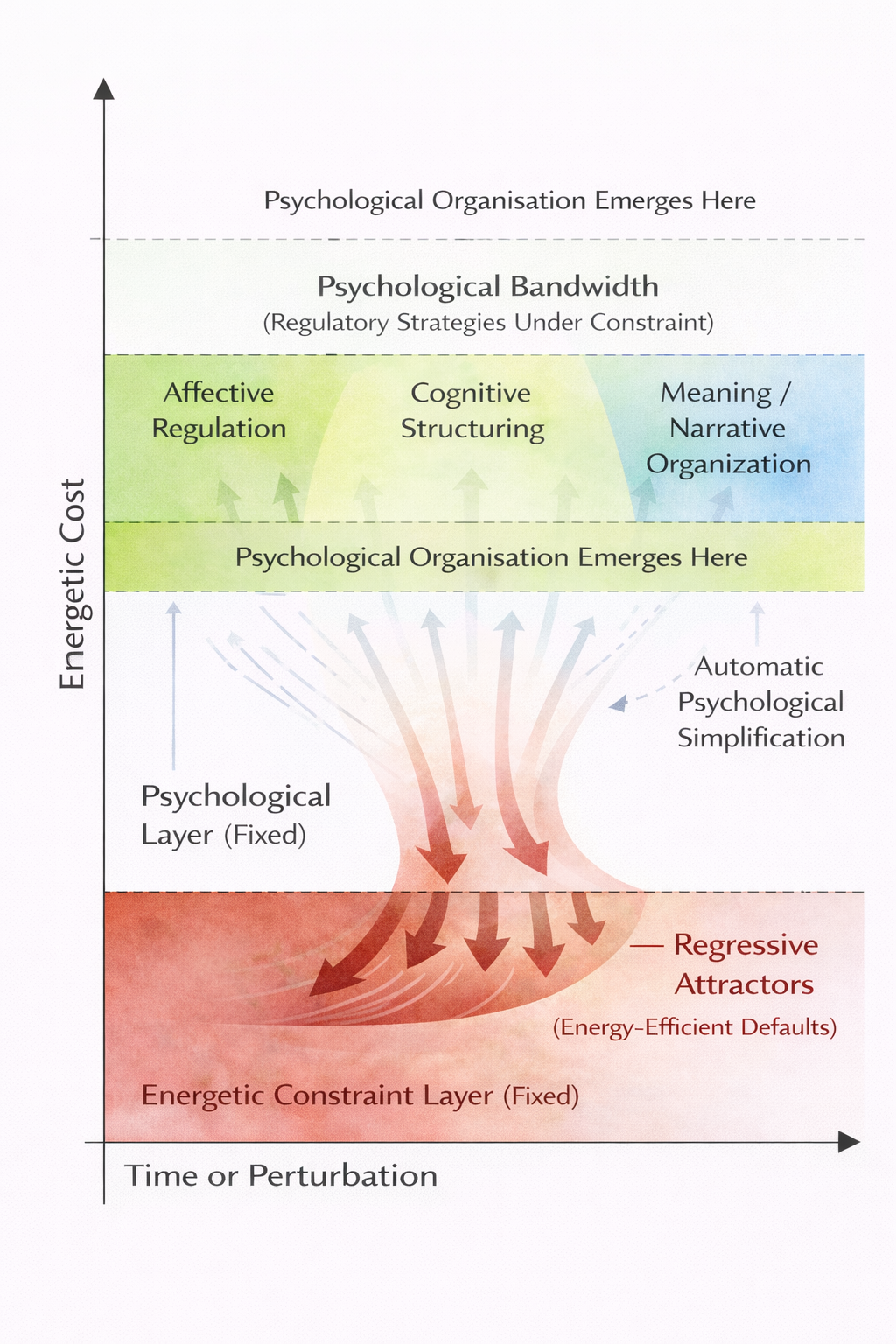
This diagram shows how affective regulation, cognitive structuring, and meaning-based organisation operate within a limited psychological bandwidth shaped by energetic constraint. Under sufficient capacity, these regulatory strategies support flexible, differentiated psychological organisation. As energetic cost increases or perturbations accumulate, regulation becomes increasingly compressed, giving way to automatic simplification and convergence toward regressive attractors. Psychological organisation is thus neither free-floating nor purely determined, but structurally shaped by the energetic conditions under which it must operate.
Reference: Foundations, Chapter V
Emotion as Energetic Regulator
Emotions function as modulators that bias energetic allocation toward particular behavioural responses.
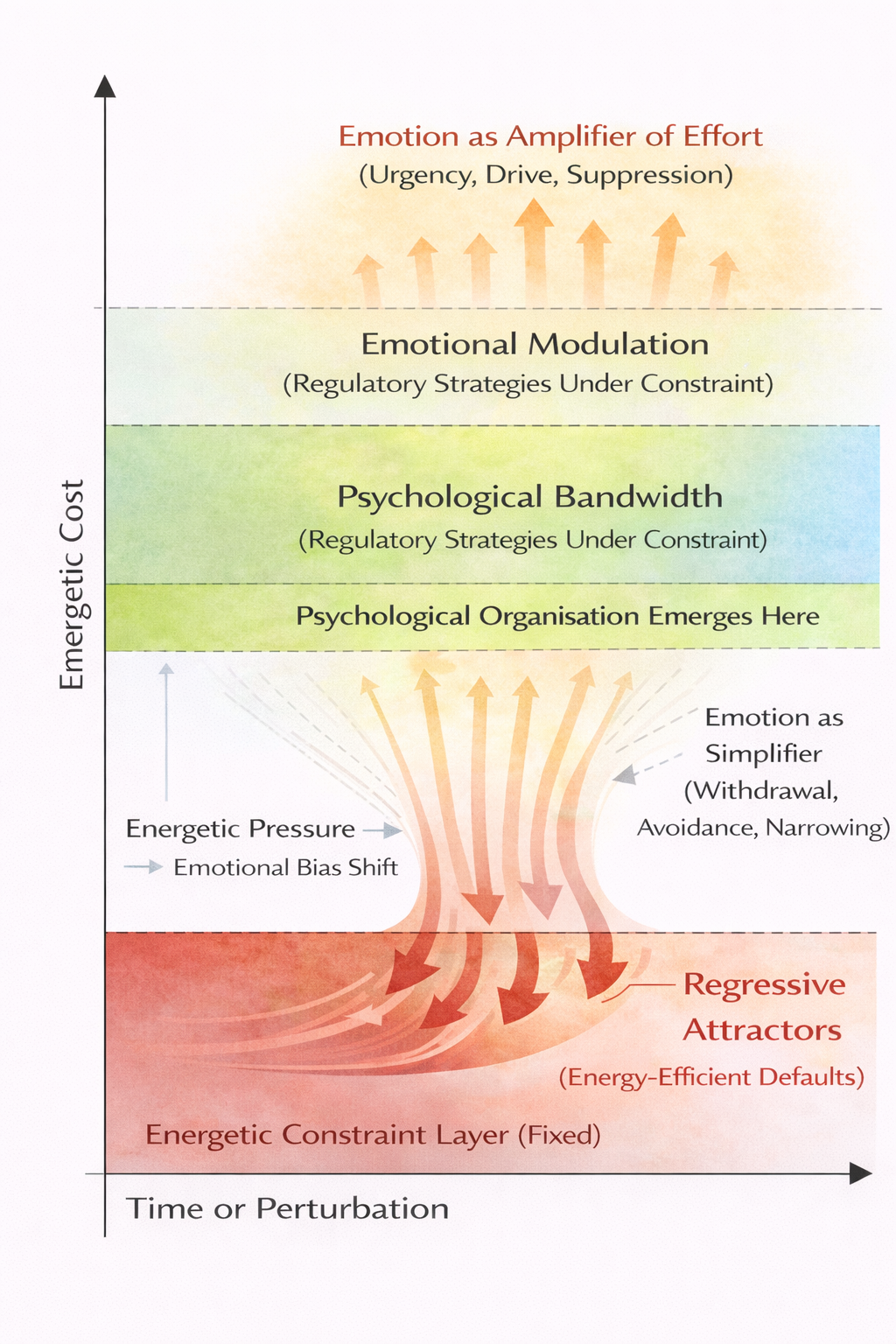
Emotional states prioritise certain actions by reallocating limited energetic resources. Under constraint, this modulation becomes increasingly rigid, reinforcing attractor capture and narrowing behavioural flexibility.
Reference: Foundations, Chapter IV
Meaning as Energetic Insurance Strategy
Meaning operates as an energetic compression mechanism that reduces regulatory complexity.
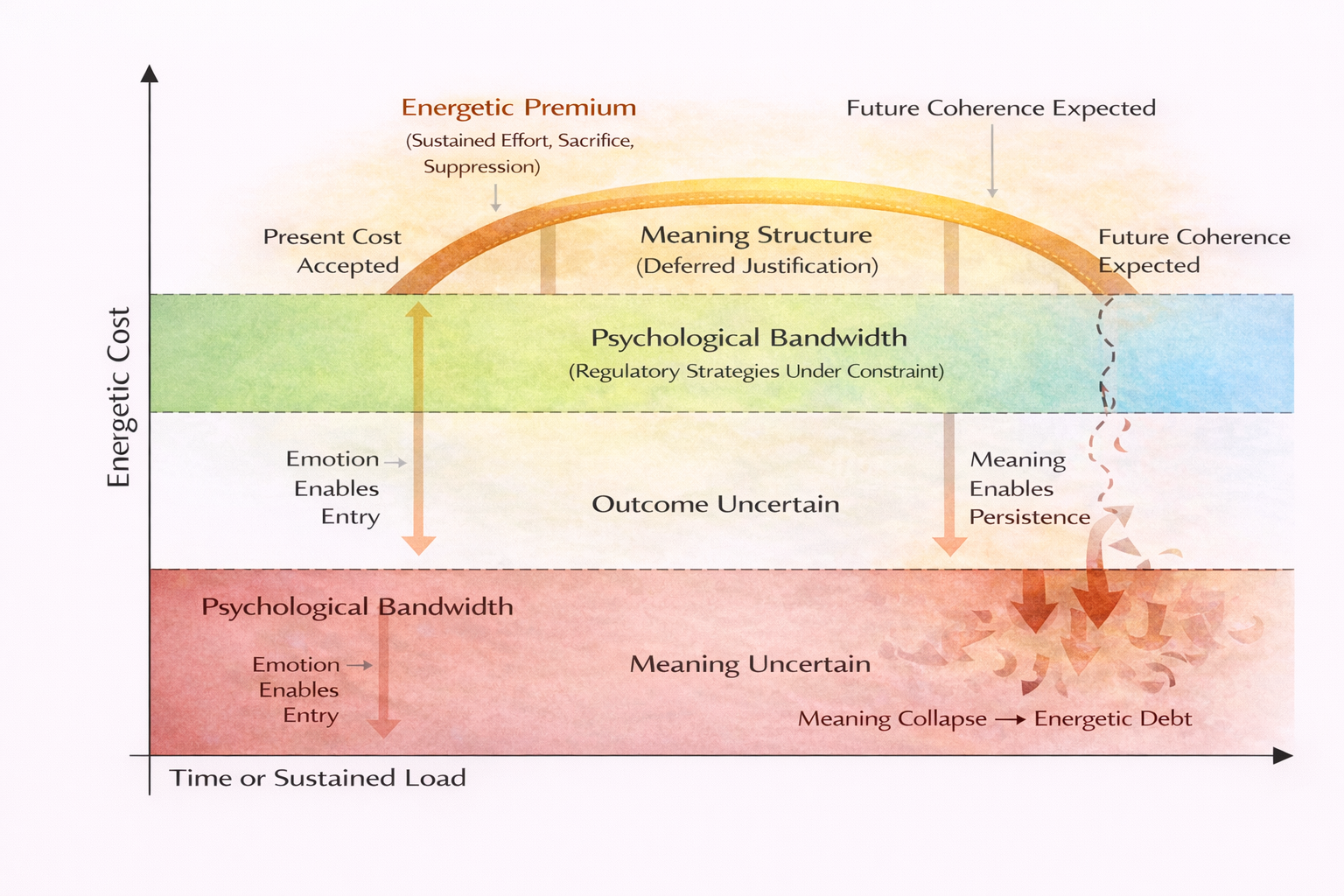
By condensing experience into stable narratives, values, or identities, meaning lowers energetic cost. While this compression enhances short-term stability, it can also increase rigidity and resistance to adaptation under changing conditions.
Reference: Foundations, Chapter V
Identity as Stabilised Attractor
Identity emerges as a stabilised attractor that economises regulation but limits adaptability.
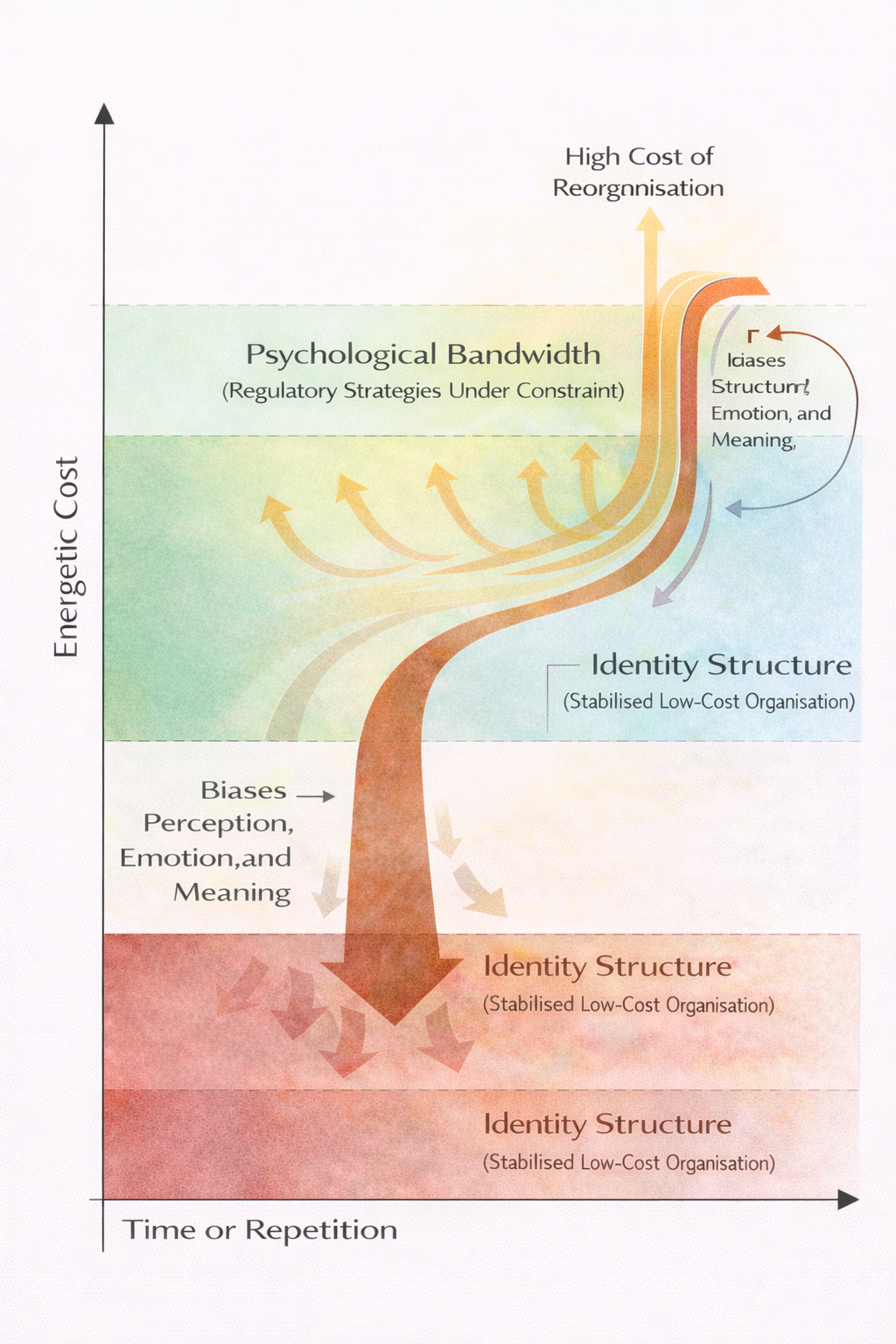
Identity formation consolidates behavioural, emotional, and interpretive patterns into a coherent structure. Under sustained constraint, this consolidation hardens, increasing resilience to disruption while simultaneously raising the cost of change.
Reference: Foundations, Chapter V
Status of These Diagrams
These diagrams define the current canonical visual language of Energetic Consciousness Theory. While future work may refine their presentation, the structural relationships they depict constitute stable reference points within the framework.