Energetic Consciousness Theory
Overview
Energetic Consciousness Theory (ECT) is a constraint-based architectural framework within the philosophy of cognitive systems that examines how multi-level conscious regulation operates under finite integration capacity. Rather than modeling neural mechanisms or computational inference, ECT articulates the structural grammar governing how coherence is maintained across biological, psychological, and social layers. The series develops a unified account of how reflexive regulation scales in cost, how regulatory success accumulates strain, and how collapse can emerge endogenously without pathology. Identity, morality, and meaning are treated not as metaphysical givens but as compression structures within this broader regulatory architecture. By centering constraint and scaling limits, ECT offers a systems-level explanation of both stability and fragility in conscious life. Across its volumes, the theory traces how increasing reflexive depth expands functional scope while simultaneously generating structural vulnerability.
Rather than treating motivation, cognition, morality, or social order as primarily informational or normative phenomena, ECT situates them within an energetic economy. Conscious states, behavioural patterns, and social structures are understood as adaptations that must remain viable under finite metabolic and regulatory capacity. Stability, in this view, is not guaranteed by coherence or health; it is often achieved through compensation, postponement, or energetic debt.
ECT does not propose a total explanation of human behaviour. Its aim is more limited and more precise: to identify the energetic boundary conditions within which consciousness operates, and to show how these constraints shape characteristic patterns of persistence, rigidity, collapse, and recovery across individual and collective systems.
ECT in One Paragraph
Energetic Consciousness Theory holds that human consciousness and behaviour are structured by finite energetic capacity, and that this constraint gives rise to stable but non-optimal behavioural patterns, or “attractors,” under sustained demand. These attractors allow systems to remain outwardly functional while accumulating internal energetic strain. Collapse, from this perspective, is not a sudden failure of motivation or meaning, but the delayed expression of energetic incoherence between capacity, demand, and regulatory organisation. Because energetic debt accumulates asymmetrically, breakdown tends to be rapid while recovery is slow, costly, and structurally constrained. ECT therefore distinguishes behavioural stability from energetic robustness and reframes many psychological, moral, and social failures as predictable outcomes of constrained adaptation rather than as pathologies or moral deficits.
Diagrammatic Overview
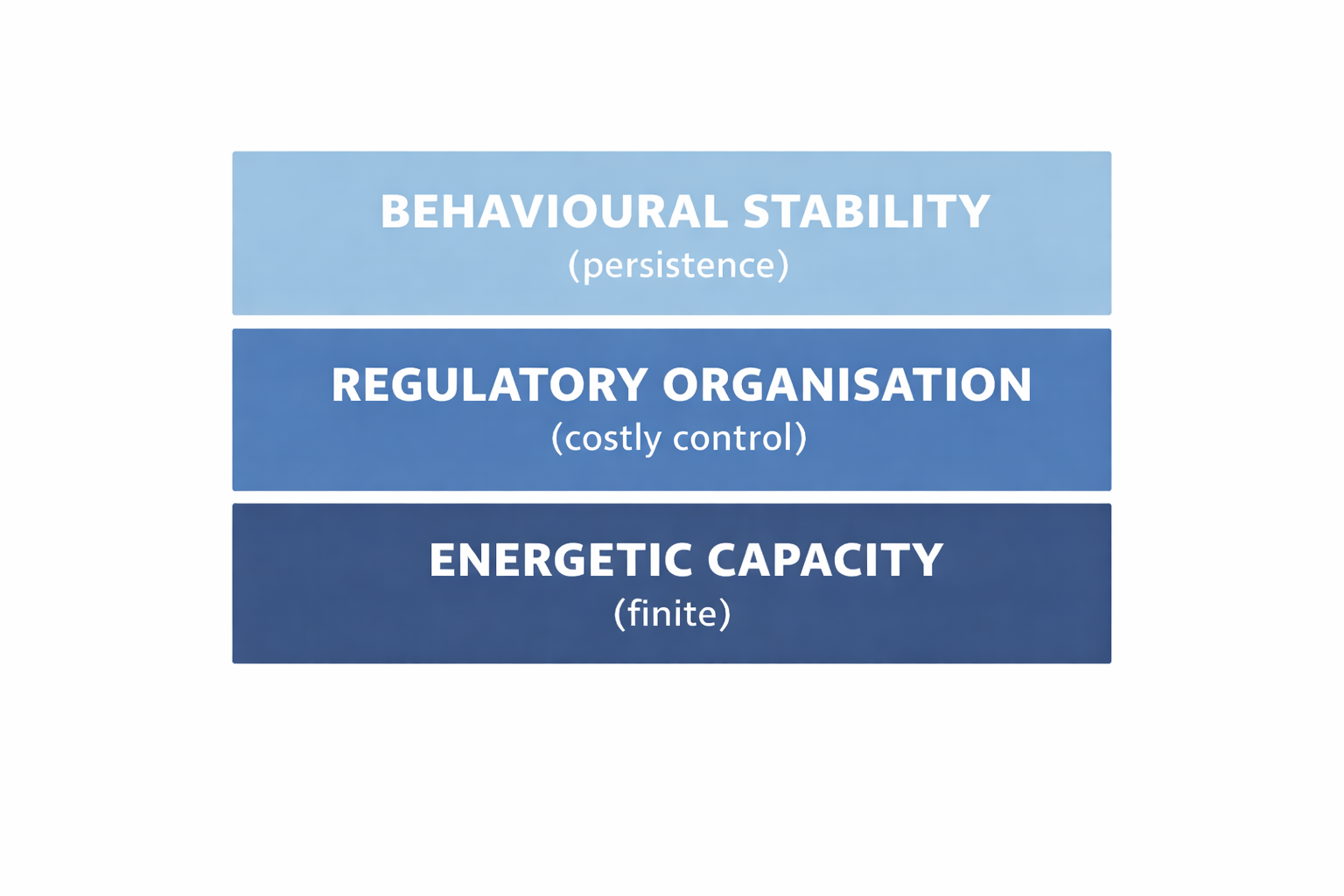
Energetic Consciousness Theory models consciousness and behaviour as layered systems whose stability depends on finite energetic capacity and compensatory regulation.
Reference diagrams defining the structural framework of Energetic Consciousness Theory
Scope and Boundary Conditions
ECT operates across multiple levels of analysis while maintaining explicit limits
It addresses:
Energetic constraints of the organism and brain
Regulatory demands of attention, effort, and control
Stabilisation of behavioural patterns under constraint
Amplification of these dynamics in social and institutional systems
It does not claim that:
Human behaviour is governed directly by thermodynamic laws
Meaning, value, or morality can be reduced to energy
All psychological or social phenomena fall within its scope
Energetic constraint functions as a framing condition: it shapes what forms of consciousness and behaviour are sustainable over time without determining their specific content.
Core Concepts
Energetic Capacity — finite metabolic and regulatory resources
Regulatory Organisation — cognitive, behavioural, and social control structures
Behavioural Attractors — stable patterns enabling persistence under constraint
Energetic Coherence / Incoherence — alignment between demand, capacity, and regulation
Asymmetry of Breakdown and Recovery — rapid collapse versus slow reorganisation
These concepts are structural tools, not metaphors, and can be applied across contexts without reductionism.
Relation to Existing Approaches
ECT intersects with cognitive and affective neuroscience, psychology of effort and self-regulation, systems theory, and moral and political philosophy. Its distinctive contribution is to integrate energetic limitation into the analysis of consciousness and behaviour without treating energy as a sufficient explanation.
Rather than replacing existing approaches, ECT clarifies why systems often persist despite fragility and why failure appears disproportionate to immediate causes.
Audience and Status
ECT is intended for general readers, advanced intellectual audiences, and academic readers in philosophy, psychology, cognitive science, and social theory.
The theory’s core architecture is defined. Its empirical integration and philosophical implications continue to be developed through formal publication and scholarly engagement. ECT is offered as a constrained model designed to explain why human systems persist as they do, why they fail in characteristic ways, and why recovery is often harder than collapse once energetic limits are exceeded.
Publications and Structure
The framework is currently articulated through two complementary volumes:
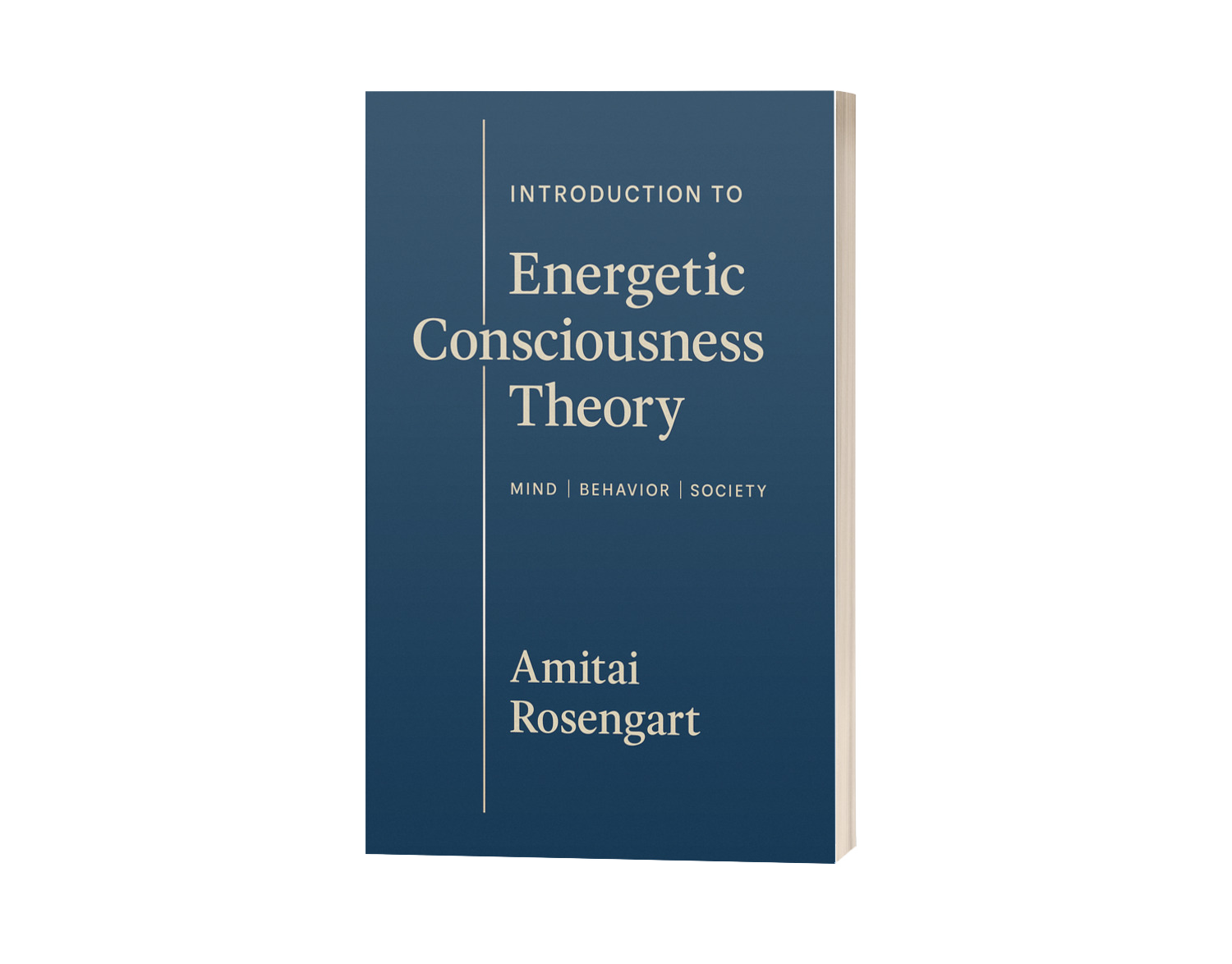
Introduction to Energetic Consciousness Theory — offers an accessible entry point
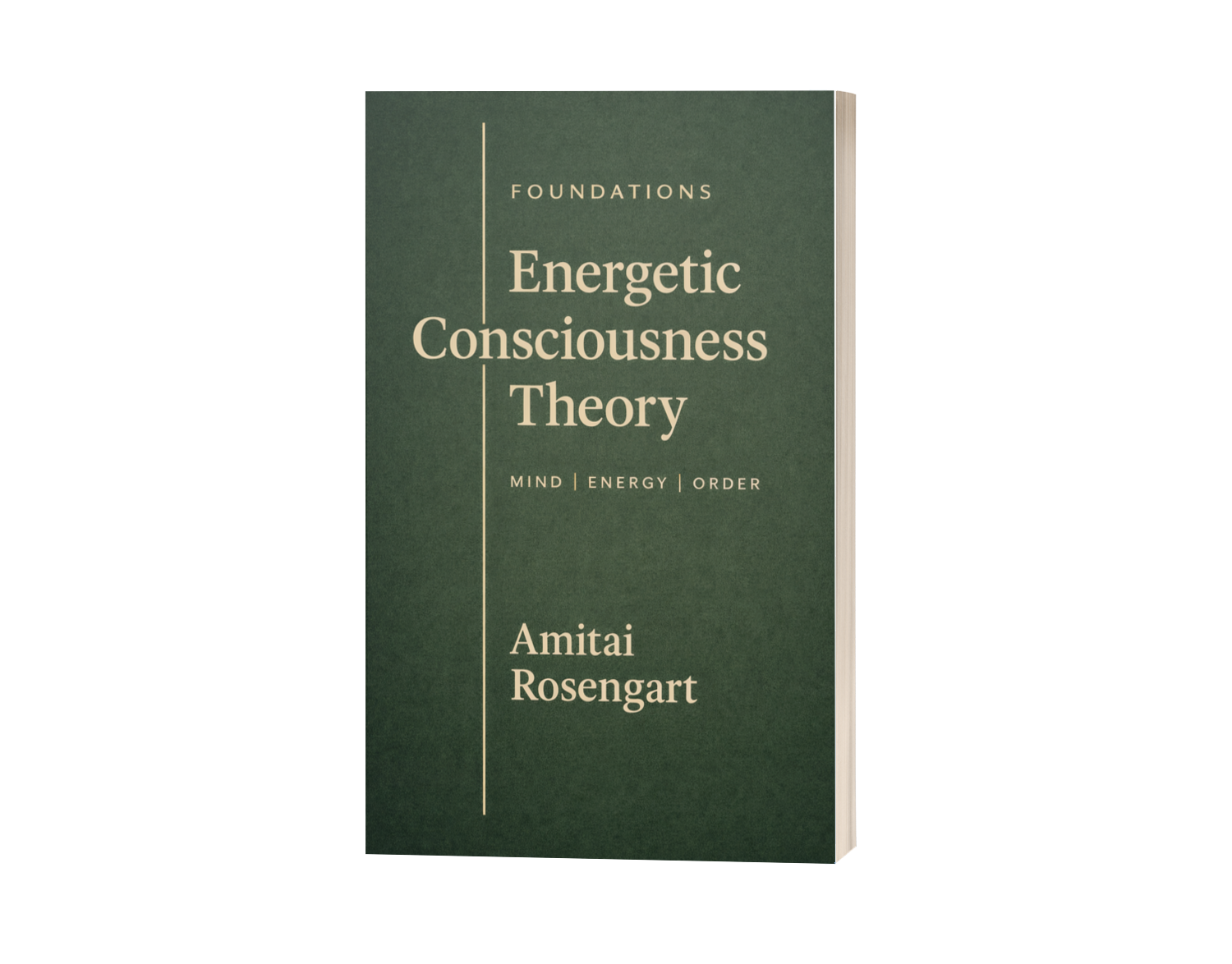
Energetic Consciousness Theory: Foundations — canonical articulation of Energetic Consciousness Theory
In parallel, several scholarly articles are under review or in submission.